-
[양재혁의 바이오Talk 헬스Talk] 소버린 의료 AI로 여는 한국 태국 협력의 미래ARTICLE 2026. 11. 3. 17:18
2026년 10월 30일, 태국 방콕 트루 디지털 파크에서 열린 ‘Global Medical AI Summit 2026(GMAI 2026)’에 참가했다. 이번 행사에서 돌아보게 된 질문은 분명했다. 의료 현장에 AI를 도입할 때, 그 기술을 누가 이해하고 통제하며 발전시킬 것인가. 의료진과 환자에게 필요한 AI를 만들기 위해 각국은 어떤 역량을 갖춰야 하는가. 태국에서 만난 소버린 의료 AI에 관한 논의는 이러한 질문에서 출발했다.
On October 30, 2026, I attended the Global Medical AI Summit 2026 (GMAI 2026) at True Digital Park in Bangkok, Thailand. The event prompted a fundamental question: when AI enters healthcare, who will understand, control, and improve the technology? What capabilities must countries build to develop AI that serves their clinicians and patients? These questions framed the discussions on sovereign medical AI that I encountered in Thailand.
의료 AI는 진료기록과 환자의 건강정보를 다루고, 의료진의 판단과 병원의 업무에 영향을 미친다. 따라서 성능이 좋은 서비스를 확보하는 일과 함께 자국의 언어와 의료체계에 맞게 검증하고 안정적으로 운영할 기반을 갖추는 일이 중요하다. 의료정보의 이용 원칙과 기술의 운영 방향을 스스로 결정할 수 있는지가 국가 의료체계의 지속 가능성과 연결되기 때문이다.
Medical AI handles clinical records and patient health information, influencing clinical decisions and hospital workflows. Alongside access to capable technology, countries need the foundations to validate AI against their own languages and healthcare systems and to operate it reliably. The ability to determine how health information is used and how technology is managed is closely connected to the long-term sustainability of a national healthcare system.
의료 데이터 주권과 AI 기술 주권을 함께 확보해야
Securing Both Medical Data Sovereignty and AI Technology Sovereignty이번 행사에서 ㈜아크릴(ACRYL Inc.) 신현경 부대표는 ‘소버린 의료 AI — 한국의 선도 경험, 태국의 전략적 도약’을 주제로 발표했다. 신 부대표는 의료 AI가 국가 의료체계의 경쟁력을 좌우하는 핵심 인프라로 발전하고 있다고 설명했다. 특히 각국의 의료 언어와 진료지침, 의약품 체계와 데이터 특성을 반영하고, 의료 데이터 주권과 AI 기술 주권을 함께 확보해야 한다는 점을 강조했다.
At the summit, Shin Hyun-kyung, Vice President of ACRYL Inc., delivered a presentation titled “Sovereign Medical AI: Korea’s Experience, Thailand’s Strategic Leap.” Shin explained that medical AI is becoming core infrastructure that shapes the competitiveness of national healthcare systems. The presentation emphasized the need to reflect each country’s medical language, clinical guidelines, pharmaceutical system, and data characteristics while securing both medical data sovereignty and AI technology sovereignty.
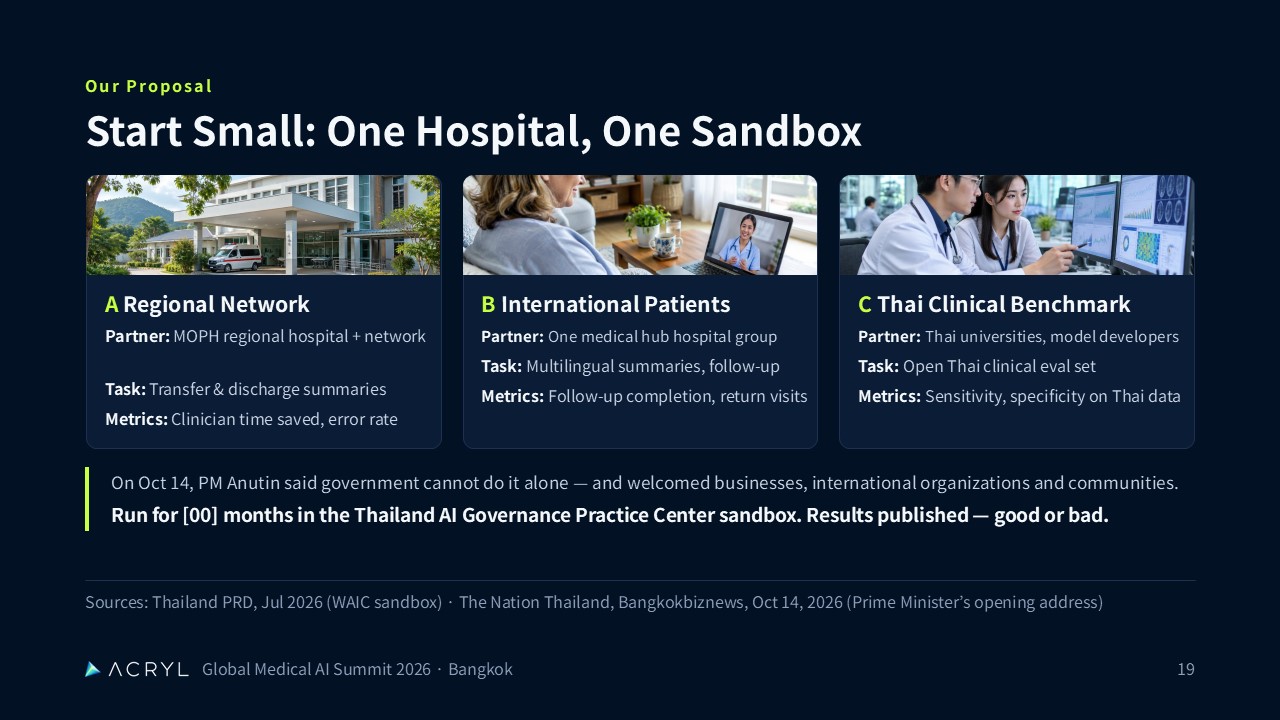
아크릴은 태국의 샌드박스에서 소버린AI를 함께 구축하자는 제안을 설명했다. / Acryl presented a proposal to build "Sovereign AI" in collaboration with Sandbox in Thailand. 소버린 의료 AI는 국가와 기관이 자국의 의료 환경에 맞는 AI를 개발·선택·운영하고, 데이터와 기술 활용에 대한 통제권을 확보하는 접근이다. 태국이라면 태국어 의무기록과 의료용어, 현지 진료지침과 의약품 정보를 반영하고 태국 의료진이 성능과 안전성을 검증할 수 있어야 한다. 환자정보의 저장 위치와 접근권한, 외부 전송 여부를 관리하고, AI 답변의 근거와 처리 이력을 확인하는 운영체계도 필요하다. 해외 기술을 활용하더라도 현지 기관이 모델의 선택과 교체, 업데이트를 결정하고 서비스를 지속할 역량을 갖추는 것이 핵심이다.
Sovereign medical AI means enabling countries and institutions to develop, select, and operate AI suited to their healthcare environments while retaining control over data and technology use. For Thailand, this requires incorporating Thai-language medical records and terminology, local clinical guidelines, and drug information, with Thai clinicians able to assess performance and safety. It also requires operational systems to govern where patient information is stored, who can access it, whether it is transferred externally, and how the supporting evidence and processing history behind AI outputs can be reviewed. Even when using foreign technology, local institutions need the authority and capabilities to select and replace models, manage updates, and sustain services.
이러한 관점은 태국의 의료 현실과 맞닿아 있다. 태국은 보편적 건강보장과 디지털 헬스 기반을 발전시켜 왔지만 의료인력의 지역적 편중과 기관별로 분산된 정보, 늘어나는 의료 수요에 대응해야 한다. 의료 AI는 전원 환자의 기록 정리와 진료정보 검색, 의료기관 간 정보 전달을 지원할 수 있다. 다만 현지 언어와 진료 과정을 충분히 이해하지 못하면 업무를 줄이기보다 새로운 확인 부담을 만들 수 있다. 태국의 의료진이 현지 데이터로 검증하고 개선할 수 있는 체계가 필요한 이유다.
This perspective is directly relevant to Thailand’s healthcare realities. The country has advanced universal health coverage and digital health infrastructure, yet must still address uneven geographical distribution of health workers, fragmented institutional information, and growing demand for care. Medical AI can help organize records for transferred patients, retrieve clinical information, and support information exchange between facilities. However, insufficient understanding of local language and clinical workflows can create additional verification work rather than reduce workloads. Thai clinicians therefore need systems they can validate and improve using local data.
태국 의료를 위한 공동 개발 전략
A Joint Development Strategy for Thai Healthcare신 부대표가 제안한 ‘Thai-Ready Medicine’은 이 문제를 해결하기 위한 협력 방향이었다. 한국에서 축적한 의료 AI 구축 경험을 바탕으로 태국의 언어와 의료체계, 임상 데이터를 반영한 모델을 현지 의료기관 및 기업과 공동 개발하자는 구상이다. 태국의 파트너가 개발과 평가, 운영에 참여하면서 필요한 역량을 축적할 수 있도록 협력하자는 데 의미가 있다.
Shin’s proposed “Thai-Ready Medicine” strategy outlined a collaborative response. Drawing on Korea’s experience in implementing medical AI, it envisions developing models jointly with Thai healthcare institutions and companies, incorporating Thailand’s language, healthcare system, and clinical data. Its significance lies in enabling Thai partners to build capabilities through participation in development, evaluation, and operations.
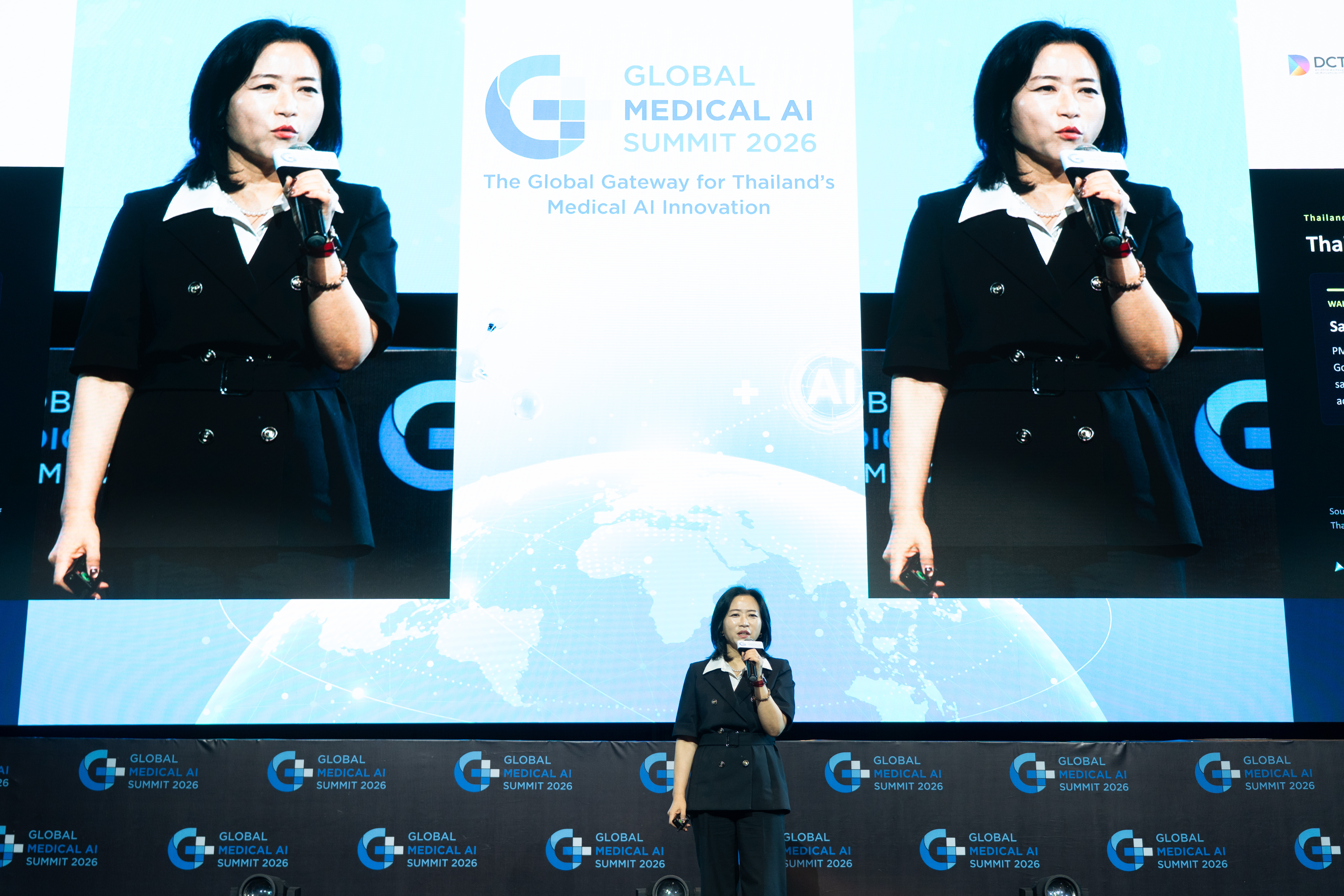
신현경 부대표 발표사진 / A photo of Vice president Shin Hyun-kyung giving a presentation. 발표에서 소개한 기술 체계도 이러한 방향을 뒷받침한다. 아크릴은 AI 인프라 운영관리 플랫폼 ‘Jonathan.H’, 병원 데이터를 AI가 활용할 수 있는 형태로 정비하는 ‘NADIA-ANE’, 보건의료 파운데이션 모델 ‘ALLM.H2 FRANK’를 제시했다. 병원 내 컴퓨팅 자원을 운영하고, 데이터의 의미와 구조를 정리하며, 의료지식을 반영한 모델을 구축하는 과정이 서로 연결돼야 한다는 설명이다. 소버린 의료 AI를 구현하려면 모델 개발뿐 아니라 데이터 기반과 운영 인프라를 함께 갖춰야 한다.
The technology architecture presented at the summit supports this approach. ACRYL introduced Jonathan.H, its AI infrastructure operations platform; NADIA-ANE, which prepares hospital data for AI use; and ALLM.H2 FRANK, its healthcare foundation model. The underlying principle is that hospital computing resources, the meaning and structure of clinical data, and models incorporating medical knowledge must work together. Building sovereign medical AI requires data foundations and operational infrastructure alongside model development.
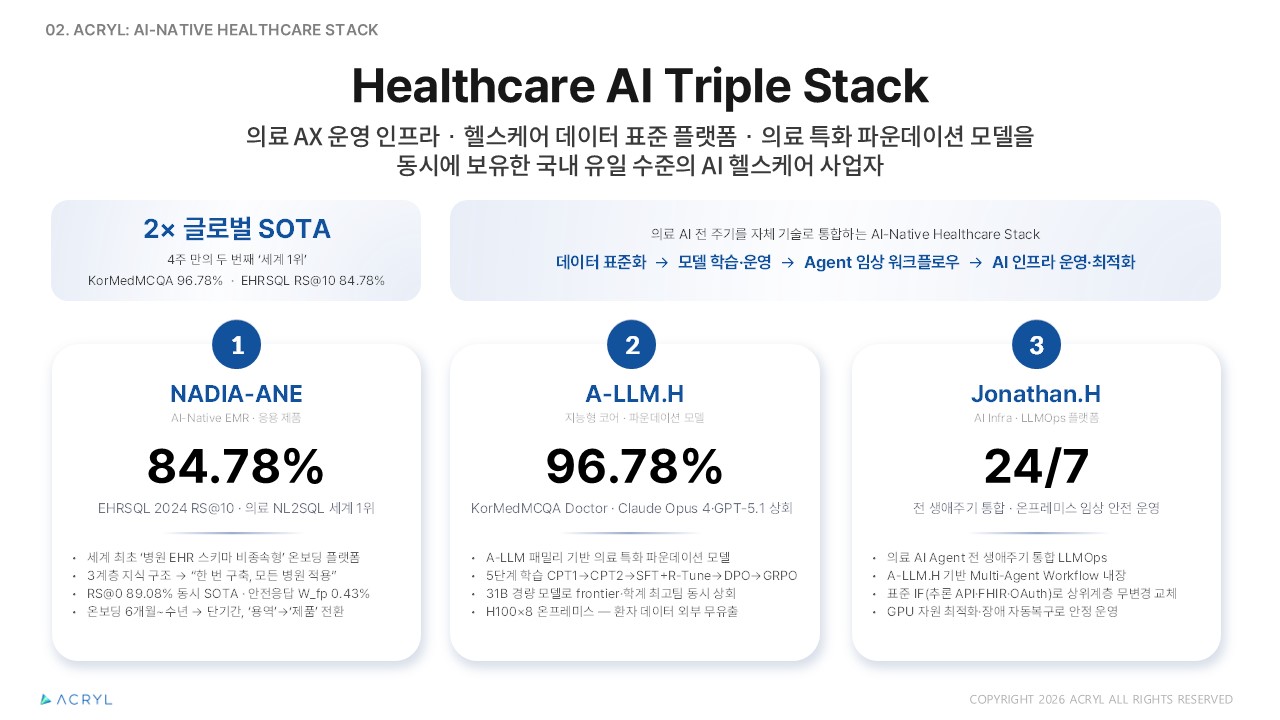
'AI-Native Healthcare Stack' ▲병원 데이터 주권을 담당하는 'NADIA-ANE' ▲의료 특화 모델 주권을 담당하는 'ALLM.H' ▲AI 모델과 에이전트 운영을 맡는 'Jonathan.H' / 'AI-Native Healthcare Stack' ▲ 'NADIA-ANE' for hospital data sovereignty ▲ 'ALLM.H' for sovereignty over medical-specific models ▲ 'Jonathan.H' for the operation of AI models and agents. 아크릴은 GPU 가동률을 55%에서 93%로 높인 운영 사례, 한국 의사국가시험 435문항 전 문항 정답, 실제 병원 기록 기반 질의 1,167건에서 오답률 0.6%를 기록한 평가 결과도 소개했다. 이는 회사가 제시한 특정 운영 및 평가 조건의 결과로 이해해야 한다. 한국어 환경에서의 시험 성적과 기록 질의 성능이 태국 임상 현장의 안전성이나 진료 효과를 보장하는 것은 아니다.
오히려 이러한 경험을 태국에서 어떤 기준으로 다시 평가하고 개선할 것인지가 공동 개발의 중요한 과제가 된다.
ACRYL also shared an operational example in which GPU utilization rose from 55% to 93%, an evaluation reporting correct answers to all 435 questions from a Korean medical licensing examination, and a reported error rate of 0.6% across 1,167 queries based on actual hospital records. These should be understood as company-reported results under specific operational and evaluation conditions. Korean-language examination scores and record-query performance do not guarantee safety or clinical effectiveness in Thailand. Establishing how to reassess and improve these capabilities in the Thai context is an important task for joint development.
한국의 국가 연구개발 경험을 협력 기반으로
Building Cooperation on Korea’s National Research and Development Experience신 부대표가 제시한 협력 방향은 지역·공공·필수의료 지원, 태국형 보건의료 파운데이션 모델 공동 개발, 의료 AI 개발 방법론의 현지 적용을 전략으로 제시 했다. 지방 공공병원의 진료 지원에 한국의 국가 과제 경험을 활용하고, 태국어와 현지 의료지식을 반영한 모델을 함께 개발하며, 데이터 표준화부터 모델 평가와 임상 검증까지의 과정을 현지에 정착시키자는 제안이다. 현재의 기술을 활용하는 동시에 태국이 다음 단계의 기술을 발전시킬 수 있도록 기반을 만드는 접근이다.
Shin outlined cooperation in regional, public, and essential healthcare; the joint development of a Thai healthcare foundation model; and the local adoption of medical AI development methodologies. The proposal would draw on Korea’s national project experience to support care in provincial public hospitals, jointly develop models incorporating Thai language and medical knowledge, and establish local processes spanning data standardization, model evaluation, and clinical validation. The aim is to apply current technology while creating the foundations for Thailand to develop its next generation of capabilities.
이 과정에서 한국의 국가 연구개발 경험도 의미를 갖는다. 신 부대표는 한국 의료 AI 성장의 배경으로 정부 주도 연구개발 사업인 ‘닥터앤서’를 소개했다. 아크릴은 닥터앤서 2.0·3.0·3.1과 한국형 ARPA-H 에이전틱 AI 과제 등에서 축적한 경험을 태국과의 협력에 연결하겠다는 방향을 제시했다. 여기서 공유할 수 있는 자산은 기술과 함께 정부·기업·대학·병원이 공동의 문제를 정의하고 현장에서 검증해 온 경험이다.
Korea’s national research and development experience is relevant to this effort. Shin highlighted the government-led Dr. Answer program as a contributor to the growth of Korean medical AI. ACRYL proposed drawing on experience accumulated through Dr. Answer 2.0, 3.0, and 3.1, as well as Korea’s ARPA-H agentic AI projects, in its cooperation with Thailand. The assets to be shared include both technology and experience in bringing government, industry, universities, and hospitals together to define common problems and validate solutions in practice.
소버린 의료 AI를 키우는 협력 생태계
A Collaborative Ecosystem for Sovereign Medical AI의료 AI가 병원에 정착하기까지는 여러 주체의 참여가 필요하다. 대학은 지식과 인재를 제공하고, 병원은 실제 임상 수요와 평가 환경을 제시한다. 기업은 기술을 제품과 서비스로 구현하며, 정부는 제도와 공공 지원을 마련한다. 투자기관은 검증과 사업화에 필요한 자원을 뒷받침한다. 소버린 의료 AI를 구축하는 일은 이들이 데이터 이용과 평가, 운영의 책임을 함께 설계하는 과정이기도 하다.
Embedding medical AI in hospitals requires participation from multiple stakeholders. Universities contribute knowledge and talent, while hospitals identify clinical needs and provide evaluation settings. Companies turn technology into products and services, governments establish policy frameworks and public support, and investors provide resources for validation and commercialization. Building sovereign medical AI also means designing shared responsibilities for data use, evaluation, and operations.

태국의 Prof. Dr. Yodchanan Wongsawat (태국 부총리 겸 고등교육과학연구혁신부 장관)은 현재 태국 Medical AI 산업 육성의 핵심 정책 추진자 중 한 명임. 특히 단순한 연구개발 지원이 아니라 "Medical AI 생태계 구축 → 인증 → 사업화 → 해외진출"까지 전주기 지원하는 비전을 제시함. / Prof. Dr. Yodchanan Wongsawat Deputy Prime Minister and Minister of Higher Education, Science, Research and Innovation Prof. Dr. Yodchanan Wongsawat (Deputy Prime Minister and Minister of Higher Education, Science, Research and Innovation) is currently one of the key policy drivers fostering Thailand's Medical AI industry. In particular, he has presented a vision that goes beyond simple R&D support to provide full-cycle support, encompassing "establishing a Medical AI ecosystem → certification → commercialization → global expansion." 태국의 TILSNA와 태국 인공지능 기업가 협회(AIEAT)는 이러한 연결을 돕는 주체다. GMAI 2026은 태국 정부의 의료 AI 혁신 상용화 생태계 조성사업의 일환으로, 의료기관과 연구기관, 기술기업과 투자자를 잇는 자리로 마련됐다. TILSNA는 연구 성과를 시험·평가, 투자와 사업화로 연결하고, AIEAT는 기업이 병원과 협력기관을 만나도록 지원한다. 의료생태계 구성원이 함께 움직이도록 하는 마중물이 필요한 이유를 보여준다.
Thailand’s Technology and Innovation in Life Sciences National Agency (Public Organization), or TILSNA, and the Artificial Intelligence Entrepreneurs Association of Thailand (AIEAT) help make these connections. GMAI 2026 was organized as part of the Thai government’s initiative to build an ecosystem for commercializing medical AI innovation, connecting healthcare institutions, research organizations, technology companies, and investors. TILSNA links research outcomes with testing, evaluation, investment, and commercialization, while AIEAT helps companies connect with hospitals and partner organizations. Their work illustrates why healthcare ecosystems need institutions and initiatives that catalyze collaboration.
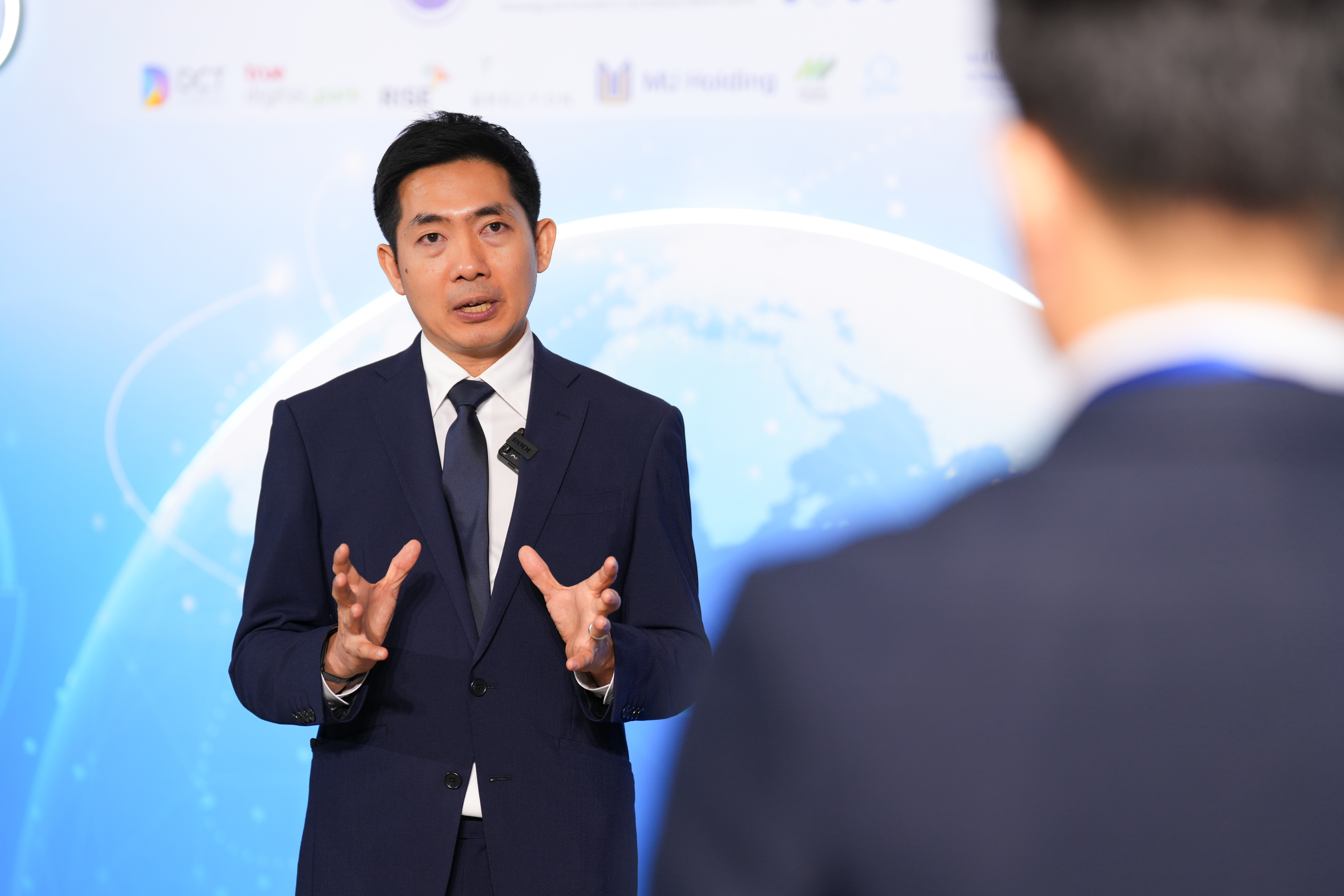
Dr. Chanwit Boonchuay 태국 인공지능 기업가 협회(AIEAT) 회장 겸 시냅스 태국(Synaps Thailand) CEO / Dr. Chanwit Boonchuay President of the Artificial Intelligence Entrepreneur Association of Thailand (AIEAT) and CEO of Synaps Thailand 태국 현지 보도를 살펴보면 국가 간 규제 협력이 주목할 대목이다. 현지 행사 보도에는 태국·싱가포르·말레이시아·인도네시아 4개국 간 의료기기 등록 규제 협력을 추진하는 방향이 소개됐다. 국가별 절차에 대응하는 부담을 줄이고 의료 혁신의 확산을 돕기 위한 움직임으로 이해할 수 있다. 다만 이는 협력 추진에 관한 내용으로, 인허가 통일이나 자동 상호인정이 완료됐다는 의미는 아니다. 제도적 협력이 진전되더라도 언어와 환자군, 진료 환경에 따른 성능 검증은 여전히 중요하다.
Thai media coverage also considered both technology and its surrounding ecosystem. BT beartai focused on bringing medical AI from laboratories into hospitals, while Tatler Asia examined Thailand’s ambition to evolve from a healthcare service hub into a country that generates research and innovation. Hfocus and NBT World introduced programs supporting research, testing, certification, and commercialization. Together, these developments suggest that Thailand seeks to be both a user of medical AI and an active participant in its development, validation, and creation of economic value.
이처럼 소버린 의료 AI는 국제 협력 속에서 발전할 수 있다. 공동으로 기술을 개발하되 각국의 의료기관이 데이터 이용과 운영에 필요한 결정을 내리고, 자국의 의료진이 성능을 평가하며, 현지 인력이 유지관리와 개선을 담당할 수 있도록 역량을 쌓는 방식이다. 협력의 성과는 도입한 시스템의 수와 함께 현지에 남는 지식과 인재, 운영 능력으로도 평가할 수 있다.
Cross-border regulatory cooperation is another development worth following. Local event coverage described efforts to promote cooperation on medical device registration regulations among Thailand, Singapore, Malaysia, and Indonesia. Such efforts can be understood as a way to reduce the burden of navigating different national procedures and help medical innovation reach more markets. However, this refers to cooperation being pursued, not completed regulatory unification or automatic mutual recognition of approvals. Even as regulatory collaboration advances, performance must still be assessed against differences in language, patient populations, and clinical settings.
Sovereign medical AI can develop through international cooperation. Technology can be developed jointly while healthcare institutions in each country retain decision-making authority over data use and operations, local clinicians evaluate performance, and local personnel build the capabilities to maintain and improve systems. The value of cooperation can therefore be assessed through the knowledge, talent, and operational capabilities it leaves locally, as well as the number of systems deployed.
7월의 첫 만남에서 10월 방콕까지
From the First Meeting in July to Bangkok in October이번 태국 출장으로 이어진 관계의 출발점은 지난 7월 주한 태국대사관이 주최한 행사였다. 7월 22일 열린 ‘Thailand–Korea Business Forum: Biohealth, Medtech, Wellness, and Future Food’는 대학과 정부기관, 병원과 기업이 만나 양국의 협력 가능성을 논의하는 자리였다. 그때 시작된 인연이 이후의 교류를 통해 새로운 사람과 기관을 연결했고, 이번 방콕 방문으로 이어졌다.
The relationships that led to this visit began at an event hosted by the Royal Thai Embassy in Seoul in July. Held on July 22, the “Thailand–Korea Business Forum: Biohealth, Medtech, Wellness, and Future Food” brought together universities, government agencies, hospitals, and companies to discuss opportunities for bilateral cooperation. The connections formed there expanded through subsequent exchanges, introducing new people and institutions and eventually leading to this visit to Bangkok.9월에는 협력의 의제를 구체화하는 기회가 마련됐다. 9월 8일 오후 일정으로 안내된 ‘한–태 바이오·메드테크 파트너십 2026’은 태국 투자청(BOI) 서울사무소가 주최하고 한국보건산업진흥원(KHIDI)과 TILSNA가 후원하는 온라인 세미나였다. 투자환경과 인센티브, 바이오·의료 산업의 협력 기회를 소개하고, 태국 기업의 기술 발표와 한국 기업의 진출 사례, 사전 매칭 방식의 비즈니스 미팅을 연결하도록 구성됐다.
September offered opportunities to make the cooperation agenda more concrete. The “Thailand–Korea Bio and Medtech Partnership 2026,” announced for the afternoon of September 8, was an online seminar hosted by the Thailand Board of Investment (BOI), Seoul Office, with support from the Korea Health Industry Development Institute (KHIDI) and TILSNA. Its program connected discussions of the investment environment, incentives, and opportunities in the bio and medical industries with presentations by Thai companies, examples of Korean companies entering Thailand, and business meetings arranged through advance matching.
같은 날 저녁에는 별도 행사인 ‘혁신신약살롱 오송’의 온라인 태국 특집이 예정돼 있었다. AI MedTech (Thailand)의 Naravut Suvannang 대표가 기존 혈액검사 데이터를 활용한 지중해빈혈 선별검사 지원 소프트웨어 ‘AIThalassemia’를 소개하는 프로그램이었다. 태국 투자청의 투자환경 발표와 TILSNA의 산업 협력 기회 발표도 이어지도록 마련됐다. 지역의 구체적인 의료 문제와 임상 데이터, 기술기업의 역량을 연결한다는 점에서 소버린 의료 AI의 필요성을 생각하게 하는 사례다.
A separate Thailand-themed online session of “Innovative Drug Salon Osong” was scheduled for that evening. Its program featured Naravut Suvannang, CEO of AI MedTech (Thailand), presenting AIThalassemia, software designed to support thalassemia screening using existing blood-test data. Presentations on Thailand’s investment environment by the BOI and industrial cooperation opportunities by TILSNA were also scheduled. By connecting a specific local healthcare challenge with clinical data and a technology company’s capabilities, the program offered a useful example through which to consider the need for sovereign medical AI.
7월의 만남과 9월의 협력 논의, 10월의 GMAI 2026을 함께 돌아보면 기술 협력이 발전하는 과정을 볼 수 있다. 상대의 필요를 이해하고, 구체적인 과제를 찾고, 현지에서 함께 실행할 가능성을 논의하는 과정이다. 사람을 통해 새로운 사람을 만나고, 하나의 인연이 다시 다른 인연을 만들면서 공동의 목표에 접근하게 된다.
Looking back at the July meeting, the September discussions, and GMAI 2026 in October reveals how technology partnerships develop: understanding a partner’s needs, identifying concrete challenges, and exploring what can be implemented together locally. One relationship introduces another, and successive connections bring people closer to a shared goal.
현장 실증과 휴먼 네트워크로 이어질 다음 단계
The Next Steps Through Field Pilots and Professional Networks앞으로 한·태국 협력은 작은 실증을 통해 구체화할 수 있다. 한 병원이나 지역 의료 네트워크에서 전원·퇴원 기록 요약을 시험하고, 의료진의 검토시간과 정보 누락을 측정할 수 있다. 태국어 임상 평가자료를 공동 구축하거나 국제환자의 다국어 진료정보 전달을 지원하는 과제도 논의할 수 있다. 실제 결과와 한계를 함께 확인하고 개선하는 경험이 쌓일 때 신뢰와 운영 역량도 함께 성장한다.
Korea–Thailand cooperation can become tangible through small-scale pilots. A hospital or regional healthcare network could test transfer and discharge summaries, measuring clinicians’ review time and information omissions. Other possible projects include jointly developing Thai-language clinical evaluation datasets or supporting multilingual clinical information exchange for international patients. As partners examine real results and limitations and improve their systems together, trust and operational capabilities can grow alongside the technology.
이번에 형성된 휴먼 네트워크 역시 앞으로 더 넓고 깊게 발전하기를 기대한다. 어떤 병원에 어떤 문제가 있으며, 누가 그 문제를 함께 해결할 수 있는지 알아 가는 관계가 중요하다. 연구자와 의료진, 기업과 정부기관이 서로의 역할을 이해하고 작은 약속부터 함께 이행할 때 인적 네트워크는 지속 가능한 협력의 자산이 된다.
I hope the professional networks formed through these exchanges will continue to broaden and deepen. What matters is building relationships through which people understand the challenges a hospital faces and know who can help address them. When researchers, clinicians, companies, and government agencies understand one another’s roles and begin by delivering on small commitments, these human connections become lasting assets for cooperation.
신현경 부대표의 발표가 제시한 방향도 결국 의료진의 역량을 넓히고, 지역과 환경에 관계없이 환자가 양질의 의료서비스를 받도록 돕는 데 있다.
The ultimate direction of Shin Hyun-kyung’s presentation was to expand clinicians’ capabilities and help patients receive quality healthcare regardless of their location or circumstances.
한국의 기술과 운영 경험, 태국의 임상 전문성과 현지 지식이 만나 태국이 스스로 활용하고 발전시킬 수 있는 의료 AI를 함께 만들어 가기를 바란다. 7월에 시작된 인연이 10월의 협력 제안으로 이어졌듯, 이번의 만남이 소버린 의료 AI를 현장에서 구현하는 다음 단계로 이어지기를 기대한다.
I hope Korea’s technology and operational experience can come together with Thailand’s clinical expertise and local knowledge to build medical AI that Thailand can use and improve for itself. Just as the relationships begun in July led to proposals for cooperation in October, I hope these latest connections will lead to the next stage: putting sovereign medical AI into practice.
글. 한국지능웰케어산업협회 양재혁 이사
'ARTICLE' 카테고리의 다른 글
[조병규 건축사 칼럼] 동두천 육타운 리모델링 _ 소요사이 그 두번째 (0) 2026.11.03 [정경의 병원 중간관리자 이야기] 착한 직원이라는 이름의 방치 (0) 2026.11.03 [임진우 건축가의 '함께 떠나고 싶은 그곳'] 역사와 자연이 공존하는 땅, 철원 (0) 2026.11.03 [이수경 원장의 행복을 주는 건강 코칭] 운동은 누구도 대신해 줄 수 없다 (0) 2026.11.03 [송창민 푸드애널리스트의 건강한 맛집] 소문 엄식점 (0) 2026.11.03 [김지혜 팀장의 병원디자인 라운딩] 일하는 사람을 위한 병원 (0) 2026.11.03 [의사가 들려주는 병원경영 이야기] 세계 최고 정형외과 병원의 성공 전략 및 미래 전망 보고서 (0) 2026.11.03 치료를 넘어 삶의 공간으로, 존엄을 실현하는 보바스기념병원 (하) (0) 2026.11.03
 매거진HD
매거진HD
헬스케어 디자인 매거진